

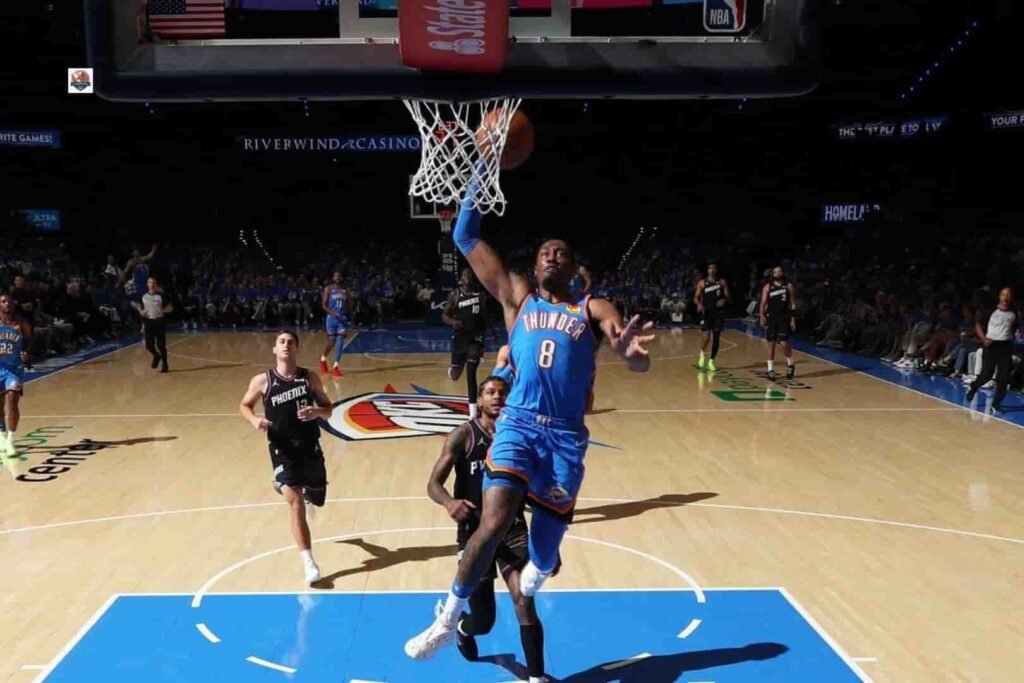
Jalen Williams Injury Scare Overshadows OKC Thunder’s Dominant Game 2 Victory Over the Phoenix Suns
★ Key Takeaways — Game 2 at a Glance
There was a moment midway through the third quarter at Paycom Center when the entire story of this game shifted. Jalen Williams — one of the central pillars of the defending champion OKC Thunder — pulled up short after a missed transition layup, walked directly to the bench, and did not come back. What had been a comfortable OKC victory suddenly carried an uneasy undercurrent. The Thunder won convincingly at 120–107, but how long Williams sits on the sideline may matter far more than Wednesday night’s final scoreline.
Before his unexpected exit, Williams had been outstanding, netting 19 points across the opening two quarters alone. With Shai Gilgeous-Alexander closing out at 37 points — the game’s individual high-water mark — OKC’s offensive engine never stalled after Williams left. Phoenix, now chasing a 2-0 deficit and managing its own mounting injury concerns, faces an increasingly steep climb if it hopes to salvage this first-round series.
The Jalen Williams Injury: Everything We Know Right Now
When and How It Happened
With approximately 5 minutes and 53 seconds remaining in the third quarter, Williams drove toward the basket in transition, released a layup attempt that fell short, and immediately showed visible discomfort. He walked to the OKC bench under his own power, received attention from the team’s medical staff, and was ruled out for the remainder of the contest. Given that OKC held a substantial lead at the time, the decision to keep him sidelined rather than risk further damage was logical — but the circumstances still raised alarm bells across the arena and throughout the basketball world.
The early indication from courtside reports pointed to the left hamstring as the area of concern. OKC’s official pre-game injury report had listed only Thomas Sorber (right ACL surgical recovery) as unavailable entering Game 2. Williams’ name was absent from that report entirely, making his mid-game departure all the more surprising to observers tracking the series.
What His Absence Means for OKC Going Forward
Williams has been the ideal complement to Gilgeous-Alexander throughout the OKC Thunder’s championship run — a versatile scorer, switchable defender, and dependable second option who gives opposing defenses no clear avenue for overloading on Shai. A short-term absence is manageable given OKC’s considerable depth, but a prolonged layoff would fundamentally reshape how this series — and any subsequent rounds — are contested. Head coach Mark Daigneault will need clear answers from his medical staff before the series shifts to Phoenix for Game 3 on April 25.
When a player of Williams’ caliber walks off mid-game and never returns, the injury conversation dominates every other storyline — no matter how comfortable the final margin appears on the scoreboard. — Game 2 Analysis, April 22, 2025
Quarter-by-Quarter Breakdown
The contest opened with genuine competition. Phoenix trimmed a nine-point deficit all the way down to a single point at 30–29 by the end of the first period, fueled by a sharp 13–5 closing run that included a Devin Booker transition bucket off a Gilgeous-Alexander miscue. That early parity, however, dissolved rapidly in the second quarter. OKC’s structured half-court attack and relentless transition game pried the gap steadily wider, and the Thunder carried a 65–57 lead into the locker room at halftime.
The third quarter proved definitive. OKC outscored Phoenix 35–20 over those twelve minutes, pushing the advantage all the way to 100–77 and rendering the fourth quarter entirely academic. Phoenix’s inability to generate clean looks against OKC’s disciplined rotational defense — compounded by a worsening turnover problem — gave the home side everything it needed to cruise.
Game 2 Performance Snapshot
OKC Thunder — Individual Leaders
| Player | Points | Role & Notes |
|---|---|---|
| Shai Gilgeous-Alexander | 37 | Game high; 29 through 3Q; led OKC wire-to-wire |
| Jalen Williams | 19 | Hamstring concern — exited Q3 at 5:53, did not return |
| Chet Holmgren | — | Starting center; critical rim protection vs PHX |
| Isaiah Hartenstein | — | Size mismatch advantage; controlled the paint |
| Lu Dort | — | Primary perimeter defender on PHX wing players |
Phoenix Suns — Individual Leaders
| Player | Points | Role & Notes |
|---|---|---|
| Dillon Brooks | 30 | Team-high; most consistent Suns performer over two games |
| Jalen Green | 18 | 17 shot attempts; volume-based output without great efficiency |
| Devin Booker | 11 | 11 at halftime; struggled against OKC’s defensive pressure |
| Royce O’Neale | 11 | Matched Booker’s total through two quarters |
| Collin Gillespie | 7 | Emergency starter in place of injured Jordan Goodwin |
Turnovers: The Hidden Margin Defining This Series
In both games of this first-round matchup, Phoenix has handed OKC a freely available scoring advantage through careless ball movement. Game 2 saw the Suns commit 16 turnovers, with OKC converting those miscues into 22 points — nearly one-fifth of the Thunder’s total output. In Game 1 on April 19, the damage was even greater: 17 turnovers that OKC turned into a staggering 34 points. It is the single most fixable issue in Phoenix’s game, yet it has persisted across both contests with no meaningful improvement.
| Game | PHX Turnovers | OKC Points Off TOs | Final Outcome |
|---|---|---|---|
| Game 1 — Apr 19 (OKC) | 17 | 34 | PHX trailed by 21 at halftime |
| Game 2 — Apr 22 (OKC) | 16 | 22 | OKC won by 13 final |
| Two-Game Combined | 33 | 56 | OKC leads series 2–0 |
Until Phoenix limits live-ball turnovers, OKC’s transition offense will keep manufacturing points that the Suns have no reliable answer for. This pattern must change in Games 3 and 4 on Phoenix’s home court, or the series will conclude well before a seventh game becomes necessary.
Full Game 2 Injury Report
Phoenix’s injury situation has been a defining undercurrent throughout this series. Mark Williams missed his second consecutive game with a foot stress reaction, while Jordan Goodwin — who aggravated a calf strain during the first half of Game 1 on April 19 — remains firmly on the sideline. Grayson Allen has been cleared as available for three straight games without actually stepping onto the court. Suns coach Jordan Ott noted before tip-off that Allen has been progressing well since suffering a left hamstring strain on April 10 against the Los Angeles Lakers, and is now in the most favorable physical condition he has been since that injury occurred. Whether he finally suits up when the series moves to Phoenix remains the team’s most pressing roster question heading into Games 3 and 4.
OKC’s Lineup Advantage: Structural, Not Accidental
The OKC Thunder opened Game 2 with a starting five of Shai Gilgeous-Alexander, Lu Dort, Jalen Williams, Chet Holmgren, and Isaiah Hartenstein — a group that handed Phoenix a noticeable size disadvantage from the opening tip. Hartenstein’s presence at center, combined with Holmgren’s positional versatility, created persistent interior problems for a Suns frontcourt already missing Mark Williams as a physical deterrent near the basket. This structural mismatch was not coincidental; it reflected a deliberate OKC game plan designed to exploit the depth gaps Phoenix carried into the series.
Collin Gillespie earned the emergency starting assignment for Phoenix in Jordan Goodwin’s continued absence, joining Devin Booker, Jalen Green, Dillon Brooks, and Oso Ighodaro in the opening unit. The adjusted Suns lineup was functional but lacked the interior presence and creative ball movement that a healthy roster might provide against an OKC defense ranked among the league’s most cohesive and disciplined units all season.
Phoenix’s Eight-Loss Playoff Drought: A Franchise at a Crossroads
Losing eight consecutive postseason games is not simply a statistical curiosity — it represents sustained failure to convert meaningful roster talent into competitive results at the highest stakes the NBA offers. Phoenix has remade itself several times over since that streak began in 2023, cycling through coaching changes, shuffling roster pieces, and acquiring high-profile additions. Yet against a structurally superior and better-coached OKC outfit, the Suns have looked tactically outgunned across both games of this series.
Dillon Brooks’ 30-point output offered a genuinely bright spot in an otherwise sobering evening for Phoenix supporters. Brooks has brought high-energy aggression in both games, but one player cannot single-handedly offset the damage done by persistent turnover problems and the absence of reliable secondary creation beyond Devin Booker. Booker himself finished the first half with 11 points — a reasonable number but well short of the 30-plus performances the Suns need from their franchise player to remain competitive against an OKC roster built specifically to limit isolation-heavy offensive systems.
NBA Playoffs 2025: OKC vs. Phoenix — Full Series Schedule
| Game | Date | Venue | Status |
|---|---|---|---|
| Game 1 | April 19, 2025 | Paycom Center, OKC | OKC Win |
| Game 2 | April 22, 2025 | Paycom Center, OKC | OKC Win — 120–107 |
| Game 3 | April 25, 2025 | Phoenix, Arizona | Upcoming |
| Game 4 | April 27, 2025 | Phoenix, Arizona | Upcoming |
| Game 5 (if needed) | April 29, 2025 | Paycom Center, OKC | Conditional |
| Games 6–7 (if needed) | TBD | PHX / OKC | Conditional |
Shai Gilgeous-Alexander: The Unquestioned Difference-Maker
If there was any lingering doubt about OKC’s capacity to compete without Williams contributing in the final quarter, Shai Gilgeous-Alexander answered it emphatically. His 37-point performance was a continuation of the form that made him one of the most compelling MVP narratives in the league this season — a blend of off-the-dribble creation, pull-up shooting efficiency, and late-clock composure that opposing defenses have simply been unable to solve consistently.
SGA’s combination of primary creation, efficient mid-range and three-point shooting, and high-IQ defensive positioning makes him the complete package at both ends — a rare pairing in modern playoff basketball. — Game 2 Observation, OKC vs. PHX
Gilgeous-Alexander had already reached 29 points through three quarters before the contest was effectively decided. His ability to sustain that level of output while managing his minutes in a blowout speaks to the efficiency — not just the volume — of his scoring. For OKC, the formula is straightforward as long as Shai remains healthy: let him operate, space the floor, and trust the defense to do the rest.
Frequently Asked Questions
Conclusion: OKC Controls This Series — But Williams’ Health Is Now Priority One
The OKC Thunder did exactly what defending champions are supposed to do in a home playoff game: they protected their court, absorbed an unexpectedly competitive first quarter, and then methodically dismantled Phoenix’s offensive structure over the following 36 minutes. Shai Gilgeous-Alexander was exceptional. The defense was suffocating. The execution was clear and purposeful from start to finish.
And yet, none of that matters quite as much as what happens with Jalen Williams in the coming days. A healthy, fully operational OKC starting lineup makes this series a near-formality. The hamstring concern introduces a layer of genuine uncertainty that OKC had otherwise largely eliminated from its postseason narrative. His status ahead of Game 3 in Phoenix on April 25 will be the most closely watched storyline in the NBA over the next 72 hours.
For Phoenix, the message is stark but clear: win both home games or face the very real possibility of first-round elimination. The Suns have the individual talent to be competitive in front of their own crowd, but the turnover epidemic and mounting injury concerns have transformed every OKC possession into a genuine threat. Something fundamental has to change at both ends of the floor — and it has to change quickly, on Phoenix’s home court, where the urgency of a playoff atmosphere may finally spark the collective response this team so badly needs.
