

By Marcus Reid • Sports Editor • April 2026 • 12 min read
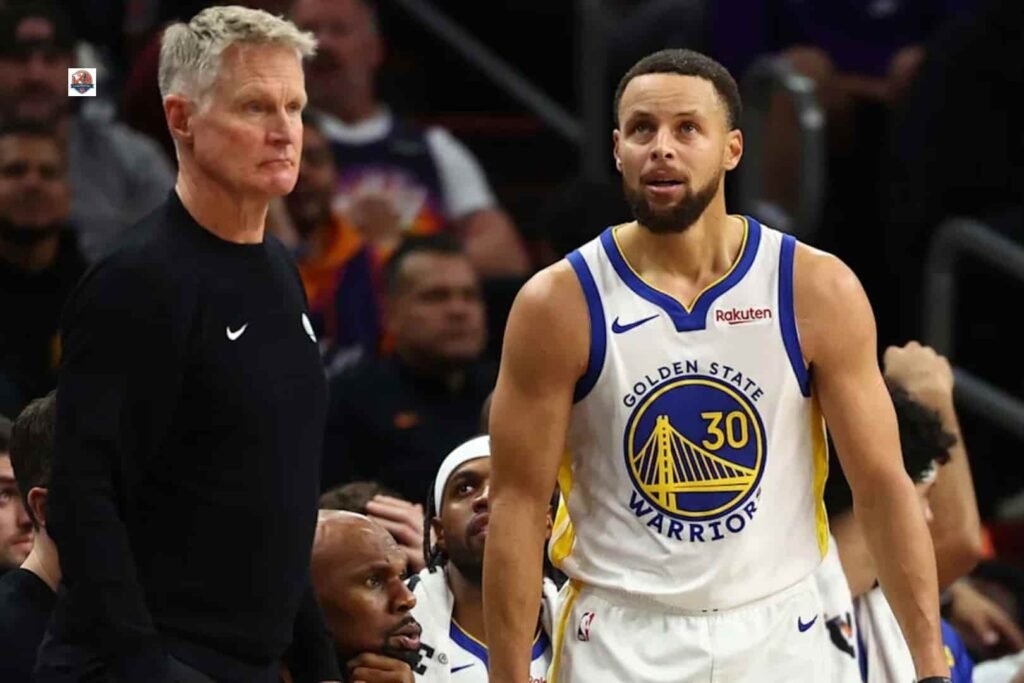
The Coach Who Can’t Quit His Star Steve Kerr Steph Curry Nobody retires from a friendship. That is the simplest way to explain why Steve Kerr’s future with the Golden State Warriors is so much harder to predict than it looks on the surface. Coaching decisions happen every spring across the NBA — teams move on, coaches reset, it’s business. But this particular situation has almost nothing to do with business. It has everything to do with the kind of bond that forms when two men spend a decade building something they both love, side by side, every single day.
| 12 Seasons as Coach | 4 NBA Titles Won | 1 Paris 2024 Gold | $63M Curry 2025–26 Pay |
More Than a Coach-Player Relationship
Let’s be honest about something: the relationship between Steve Kerr and Stephen Curry stopped being purely professional a long time ago. You can feel it in the way Kerr talks about his star player — not like a general discussing his best weapon, but like someone describing a person who genuinely changed his life. That kind of connection is rare anywhere. In professional sports, it’s almost unheard of.
Kerr arrived in Golden State in 2014 as a first-time head coach with no prior experience running an NBA team. He was smart, well-liked, and respected — but he was still a rookie in the chair. What he walked into was a roster anchored by a 26-year-old guard who had already rewritten the rulebook on three-point shooting. Steph Curry didn’t just make Kerr’s job easier. He made Kerr’s career possible in ways that even Kerr himself has acknowledged publicly on more than one occasion.
The Coach Who Can’t Quit His Star
Over twelve seasons, the two developed something that went well beyond basketball strategy. They share a similar outlook on competition, on leadership, and on what it means to show up with genuine enthusiasm every single day. Kerr has described it as two people who simply found each other at the right moment — a coach who needed a player like Curry, and a player who needed a coach like Kerr. Luck, yes. But also chemistry that couldn’t have been manufactured.
| He is the happiest and most spirited competitor I’ve ever had the chance to coach. That joy — it’s contagious. It spreads through a locker room, through a franchise, through a fanbase. You can’t teach that.” — Steve Kerr on Stephen Curry |
The Season That Changed Everything
The 2024–25 NBA season was supposed to be a reset year for Golden State. New pieces, fresh energy, a team figuring out its next identity. Instead, it became a slow-burning question mark around the man on the sideline. Steve Kerr had quietly chosen not to sign a contract extension before the season began — a decision that, at the time, felt minor. By April, it felt enormous.
The Warriors bowed out to the Phoenix Suns in what turned out to be an emotionally charged season finale. After the final buzzer, Kerr gathered his two most veteran players and said something that wasn’t about basketball at all. He told them what they meant to him as people. He told them he was grateful. Those who watched from the bench later described the scene as something that felt less like a post-game huddle and more like a farewell — even if nobody wanted to use that word.
At the press table afterward, Kerr was direct in a way that left little room for comfortable interpretation. He said he had no intention of walking away from Steph Curry. He said he would never pursue another NBA job while Curry was still playing in Golden State. But then came the pivot — the word “aligned” — and suddenly the room understood that this was not a simple stay-or-go situation. Something had to change before Kerr would commit to a 13th season.
What’s Actually Holding Kerr Back
A Voice That Felt Quieter Than It Should
People who follow Steve Kerr closely know that he has never been a coach who checks his opinions at the door. He speaks about politics, about gun control, about social justice — sometimes to standing ovations, sometimes to raised eyebrows in ownership suites. It has always been part of who he is, and for most of his time in Golden State, it was accepted as part of the package.
This past season, however, multiple sources familiar with the organization suggested that Kerr’s outspokenness had started to create friction in places it hadn’t before. The specifics remained vague — nobody inside the building was willing to put their name on anything — but the pattern was consistent enough that veteran reporters began noting it openly. One well-known NBA journalist described Kerr as feeling “hemmed in”, unable to fully be himself in the way he had been for the previous decade.
For a coach who has built his entire culture around authenticity and openness, that kind of invisible pressure is more than just uncomfortable. It is a direct contradiction of everything he
has tried to build. When the person in charge can no longer model the values he preaches, the culture starts to hollow out from the inside.
The Multi-Year Commitment Problem
Reports emerged that if Steve Kerr wanted to come back, the organization would expect him to sign a multi-year extension — not a one-year, let’s-see-how-it-goes arrangement. That expectation makes complete sense from a franchise stability standpoint. But it puts Kerr in a difficult spot. Committing to multiple years requires a level of certainty about the job, the environment, and the direction of the franchise that, as of the end of the season, he clearly didn’t have.
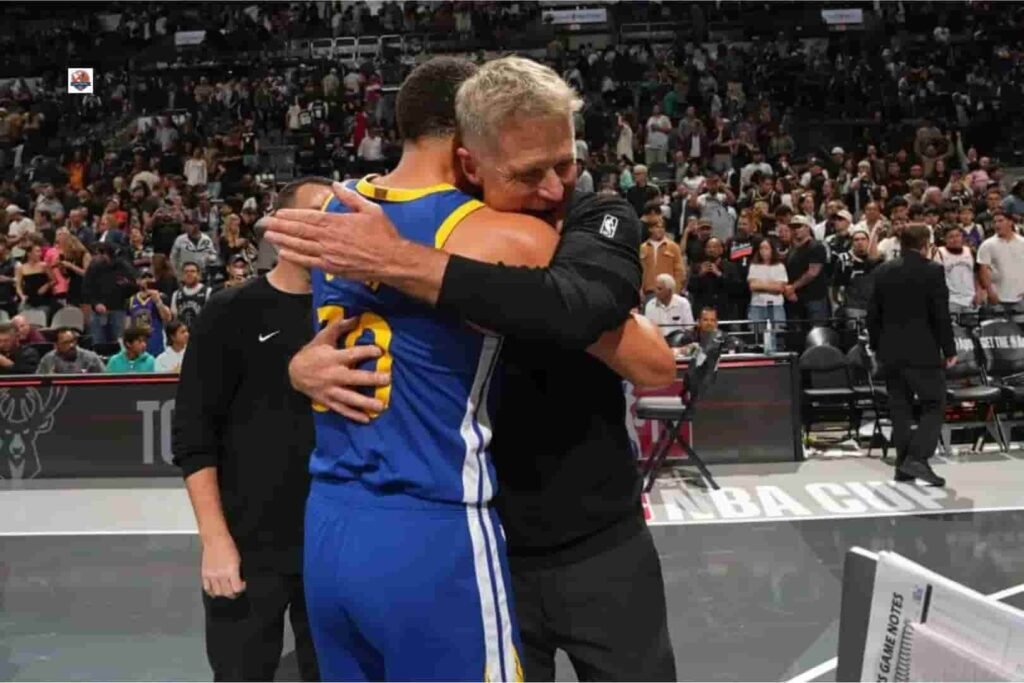
The conversation that will settle this — or at least clarify it — was expected to take place between Kerr, owner Joe Lacob, and general manager Mike Dunleavy. What gets said in that room will determine whether one of the most successful coaching partnerships in league history gets a final chapter, or whether it closes quietly with a hug on a court in Phoenix.
KEY TAKEAWAYS
- Kerr entered the 2024–25 season without signing a contract extension — a deliberate choice that signaled uncertainty
- He publicly ruled out coaching elsewhere, but stopped short of committing to return to Golden State
- Sources say Kerr felt restricted in speaking his mind on issues beyond basketball this past season
- Internal optimism about his return has cooled noticeably in the weeks following the season’s end
- Any return is expected to require a multi-year deal — a significant ask given Kerr’s current state of mind
- Curry gave Kerr full permission to make whatever decision is right for himself, not for the team
Building a Dynasty: The Kerr–Curry Timeline
| Year | Milestone | Why It Matters |
| 2014–15 | Warriors take first title | Kerr wins ring in year one; Curry earns Finals MVP honors |
| 2015–16 | 73 regular-season wins | A record-setting run that reset what teams thought was possible |
| 2017–18 | Back-to-back rings | Kerr and Curry silence every remaining doubter in the league |
| 2021–22 | Fourth championship | Curry finally claims his own Finals MVP after years of waiting |
| Paris 2024 | Team USA Olympic gold | Kerr coaches; Curry carries the flag — a perfect partnership abroad |
| 2024–25 | Season ends in Phoenix | An emotional goodbye on the court raises more questions than answers |
Curry’s Response Said Everything
After the season ended, reporters in Phoenix did something that made Stephen Curry visibly uncomfortable — they kept asking him about his coach. Not about his own game, not about the Warriors’ plans for next season, but about whether Steve Kerr was coming back. Curry handled it with the kind of composed honesty that has defined him as a leader throughout his career.
He didn’t beg. He didn’t make promises on Kerr’s behalf. He didn’t spin the situation into something more palatable for the cameras. What he said instead was something more meaningful: he wanted Kerr to come back only if Kerr genuinely wanted to be there. Not out of obligation. Not out of loyalty to Curry. Out of a real, personal desire to keep coaching.
That answer tells you more about Steph Curry than almost anything else he said all season. Here is a player who could have used his enormous influence to publicly pressure his coach into returning. Instead, he chose to set that aside and prioritize Kerr’s peace of mind over his own preferences. That’s not a transactional relationship. That’s a genuine one.
| “I want Coach to be in a good place with whatever he decides. His happiness matters more to me than my own comfort. That’s just the truth.” — Stephen Curry, Golden State Warriors |
What Happens If Kerr Walks Away?
Let’s sit with that possibility for a moment, because too many conversations skip past it. If Steve Kerr does not return, what does Golden State actually look like? Curry is still elite — still the engine, still the heartbeat of the franchise. He will play. The team will compete. A new coach will come in with ideas and energy and their own way of doing things.
But here is what goes missing: twelve years of accumulated trust. The ability to look a player in the eye during the hardest moment of a playoff run and say something they will actually believe, because it comes from someone who has been in the room with them through everything. That trust is not transferable. You cannot download it, replicate it, or hire it from somewhere else. It has to be built, and building it takes time that Golden State may not have in abundance.
Speculation around the league about possible successors to Kerr has already started circulating. Names are being floated in the way they always are when a big job appears to be opening. But the Warriors need to be clear-eyed about one thing: they are not just replacing a coach. They are replacing a culture architect. Those are two very different jobs, and the second one is far harder to fill.
Frequently Asked Questions
Q Has Steve Kerr officially decided whether to return to the Warriors?
A No official announcement had been made as of the end of the 2024–25 season. Kerr indicated a meeting with team ownership and management would take place before any decision was finalized. The outcome of that conversation was expected to determine his future with the franchise.
Q Why is Steve Kerr considering leaving Golden State after so many successful years?
A The reasons appear to be a combination of factors — a desire to speak more freely on social issues without internal friction, uncertainty about the team’s long-term direction, and questions about whether he still has the same passion for the job that drove him through the dynasty years. No single cause has been publicly confirmed.
Q How did Steph Curry react to the possibility of his coach leaving?
A Curry was measured, generous, and notably selfless in his public response. He made clear that he wants Kerr to make whatever decision is genuinely right for Kerr — not a decision based on loyalty or obligation to Curry personally. It was one of the more dignified responses to a coaching uncertainty story in recent NBA memory.
Q What would a new Warriors coach need to do to fill Steve Kerr’s shoes?
A Beyond the tactical side of the game, any successor would need to quickly build meaningful trust with Steph Curry, navigate a locker room that has a deeply ingrained culture, and establish credibility with veteran players who have won at the highest level. The coaching part is almost secondary to the relationship-building part.
Q Is Steph Curry’s future with Golden State also in question?
A Curry has said he is open to discussing a contract extension with the Warriors this summer. His commitment to the franchise appears strong, and at nearly $63 million for next season he remains one of the highest-paid players in the league. His future seems more settled than Kerr’s, at least for now.
Final Thought
There is a version of this story where Steve Kerr sits down, has the conversation he needs to have, gets the reassurances that matter to him, and comes back for one more run. In that version, he and Steph Curry get to write a proper ending — something with shape and intention, not just a goodbye hug after a loss in April. There is also a version where he doesn’t. Where the things that made him hesitate turn out to be bigger than the things pulling him back. Where the next chapter of Golden State basketball begins without the man who defined its identity for over a decade. Either way, what Kerr and Curry built together deserves to be recognized for what it genuinely was: not just a coaching relationship, not just a championship formula, but a real friendship between two people who happened to be very good at basketball. Those don’t come around often. And they don’t end cleanly...Read more
— END OF ARTICLE —
