

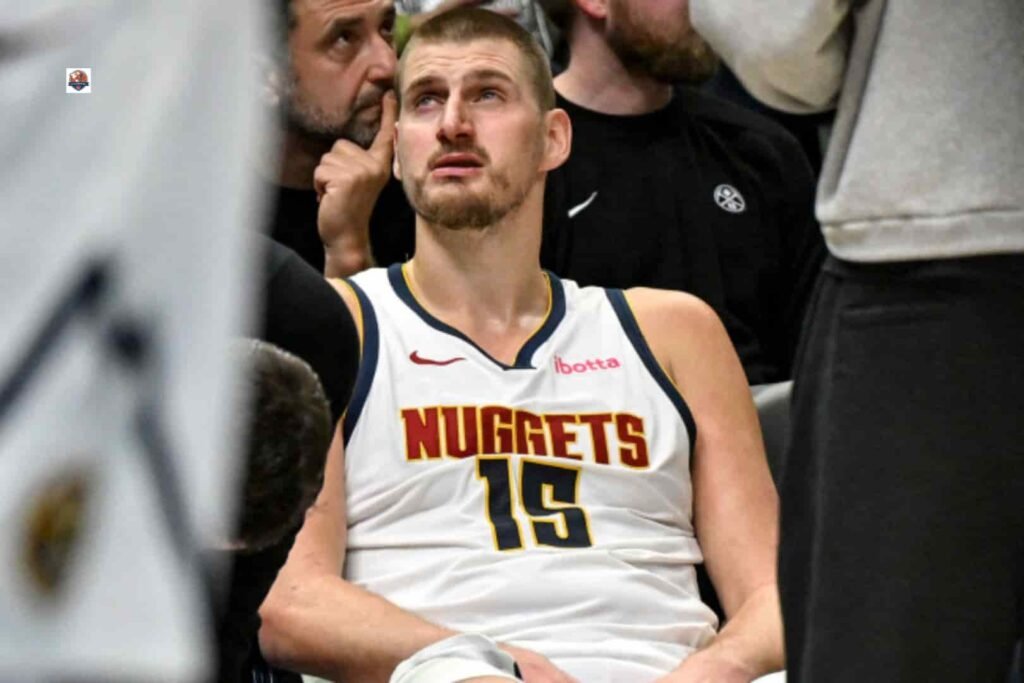
The Denver Nuggets are at a crossroads. Beaten in the first round by a shorthanded Minnesota Timberwolves squad — a team that, by most measures, had no business eliminating them — the questions are now deafening. Is Nikola Jokić’s championship window closing? Or has it simply never been properly funded?
Somewhere in the wreckage of that first-round exit is a clue. And, interestingly, one of those clues comes from an unlikely place: a 25-year-old rookie guard on the other side of the series named Terrence Shannon Jr.
The Nuggets’ Core Problem Isn’t Age — It’s NBA Title Window Closing Around Jokić?
To understand Denver’s crisis, you have to appreciate a cruel irony. This doesn’t feel like a team at the end of its run. Jokić was in the MVP conversation for most of the season. Jamal Murray had arguably his finest year as a professional. On paper, the Nuggets should be peaking. However, the figures reveal a contrasting narrative.
The core around Jokić is six years old. Six. In modern NBA terms, that’s a dynasty’s worth of wear. The championship only came three years ago, yes — but that’s because two of those six years were swallowed by Jamal Murray’s ACL tear. The window opened late, and the clock kept running anyway.
Aaron Gordon is entering his 30s with a mounting injury history and a freshly signed extension that takes him from roughly 16% of the cap to around 20% — just as his body may be reaching its limits. Christian Braun regressed significantly this past season. Cam Johnson is solid but not transformative. And the depth? Thin. Expensive. Dangerously leveraged.
Running this roster back as-is would place Denver somewhere between $20 and $30 million above the second apron as a repeat luxury tax payer. That’s a bill that demands either enormous ownership commitment or painful roster surgery…Read more
Terrence Shannon Jr. and the Timberwolves Lesson
Here’s where Terrence Shannon Jr. enters the conversation — and why Denver’s front office should be paying close attention.
Terrence Shannon Jr., the 27th overall pick in the 2024 NBA Draft out of Illinois, spent his rookie season with the Minnesota Timberwolves developing quietly. Terrence Shannon Jr. stats for the regular season — 5.6 points, 1.1 rebounds, and 0.9 assists per game in just 12.5 minutes across 43 appearances — don’t scream impact player. But late in the season, something clicked. He eclipsed 20 points in each of Minnesota’s final three regular-season games, including a gritty 26-point performance against New Orleans where he went 14-of-18 from the free-throw line, grinding his way to a team-best night.
Standing 6’6″ and 215 pounds, Terrence Shannon Jr. is an athletic, downhill scorer with the frame and physicality to compete at the NBA level. His Terrence Shannon Jr. college career — split between Texas Tech and Illinois — showed flashes of a player who could create off the dribble and punish defenses in transition. At Illinois, before legal troubles temporarily overshadowed his season, he was considered a frontrunner for National Player of the Year. The charges were ultimately dismissed, the DNA evidence exonerated him, and Shannon arrived in Minnesota carrying both the baggage of controversy and the upside of a legitimate first-round talent.
Against Denver in the playoffs, he was available — cleared from illness after missing Game 3 — and represents exactly the kind of inexpensive, ascending wing that contending teams need desperately. Young. Cheap. Under team control through restricted free agency in 2028.
The Timberwolves beat the Nuggets. Partially because of stars. But also because of depth, youth, and cost efficiency. Pieces like Terrence Shannon Jr. — on rookie deals, hungry, developing — are precisely what Denver lacks.
The Financial Cage Denver Built Around Itself
The Nuggets’ cap situation isn’t just uncomfortable. It’s a trap.
Jokić and Murray both earn max contracts. Gordon’s extension kicks in at around 20% of the cap. Johnson is owed more than $23 million annually. And the cost of retaining breakout wing Peyton Watson, or keeping Tim Hardaway Jr. — the Sixth Man of the Year finalist — would push Denver well into second-apron territory before the roster is even full.
This is a franchise that has never been a lavish spender. They only acquired a G-League affiliate in 2021.They practice in their arena, not a separate facility. They let Tim Connelly, the architect of this entire run, leave for Minnesota when a bigger offer came. There is no Joe Lacob or Steve Ballmer here. Ownership has consistently demonstrated a preference for fiscal discipline — even when the cost is competitive.
The Warriors showed what spending without apology looks like. Their 2022 title — what ESPN’s Brian Windhorst called a “checkbook win” — required somewhere around $350 million in combined payroll and luxury taxes. They signed-and-traded Kevin Durant rather than letting him walk, which eventually landed them Andrew Wiggins, who proved essential. Golden State didn’t just hope circumstances broke right. They manufactured those circumstances with money.
Denver, right now, is hoping.
What a Real Solution Looks Like
There’s no clean fix available. Trading Jamal Murray makes no sense — he just had his best season, he’s 29, and Denver’s offense collapses without his shot creation. Gordon is the more interesting trade question, though whatever defense and cutting versatility he brings in health is nearly irreplaceable. Braun, by most accounts, has negative trade value at this point.
The Hail Mary options — Kevin Durant, Anthony Davis — are exactly that. Hail Marys. Possible in theory. Not probable in practice.
The more realistic path runs through two things: spending and youth development. If Watson walks in restricted free agency, there is no obvious replacement for his production. If Johnson is dumped to cut the tax bill without a meaningful return, the rotation gets thinner and older simultaneously. These are not solutions. They’re amputations.
What Denver could use is exactly what Minnesota had on the floor when they upset them. Cheap, athletic wings on rookie contracts — players like Terrence Shannon Jr. — who bring energy, length, and improving offensive capability without breaking the bank. Denver has almost no draft capital to acquire such players. They’ve traded most of it away. That’s the deeper irony: to avoid the repeating tax, they’d have to shed the very assets that might allow them to compete long enough for Jokić to get another ring.
Jokić’s Expiring Contract Is His Most Powerful Asset
Nikola Jokić can become a free agent in 2027. He is, as of now, on one more year of guaranteed commitment to the Denver Nuggets. He could have extended last offseason. He didn’t.
Jokić has said, publicly and clearly, that he wants to be a Nugget forever. “Even if we never win anything else after this, an organic title, it means more to me than anything.” After the playoff exit, he reiterated the same sentiment. He is, by all indications, the anti-LeBron when it comes to front office maneuvering. He doesn’t make demands. He doesn’t force trades. He just plays.
But here’s the thing: he doesn’t have to re-sign immediately. And he shouldn’t.
The expiring contract is leverage, even if Jokić doesn’t see it that way. Every other franchise in the NBA — save perhaps Oklahoma City — would move heaven and Earth to acquire him. The Lakers have already carved out cap space for 2027. Luka Dončić plays there. The market for Nikola Jokić is, without exaggeration, every team on the planet. Denver should feel that heat. They should earn his re-signing, not assume it.
Tim Duncan stayed with San Antonio because San Antonio was always willing to do what it took. Stephen Curry stayed in Golden State because Golden State spent $350 million to build a winner around him. Jokić has every right to wait and see whether Denver’s ownership will do the same for him.
The Window Isn’t Closed. But It’s Closing.
Windows don’t always open and close just once. The Warriors fell to the lottery in 2020, missed the playoffs via play-in in 2021, and won the championship in 2022. Strange things happen. Injuries derail favorites. Front offices implode. The NBA is genuinely chaotic.
Denver, with a healthy Jokić, is never truly dead. The best player in the world has a way of generating improbable outcomes.
But fortune favors the prepared. The Warriors didn’t just get lucky in 2022 — they put themselves in a position where luck could work in their favor. Denver needs to do the same. That means spending. That means finding players on the right side of the age curve, even if it costs more than comfortable. It means looking at young guards and wings — players in the Terrence Shannon Jr. mold — and figuring out how to build around Jokić with youth and potential, not just veteran familiarity and declining athleticism.
Terrence Shannon Jr. stats may not demand headlines right now. His numbers are modest. But his profile — young, athletic, cheap, ascending — represents exactly the kind of value that championship rosters are built on. The Timberwolves understood that. Denver, with its dwindling assets and bloated contracts, has forgotten it.
Jokić is still elite. The window is still open. But the Nuggets are running out of time to prove that winning matters more to the organization than the bottom line does. If they can’t demonstrate that — through spending, through acquiring talent, through protecting the championship window of the greatest player in franchise history — then they deserve every uncomfortable moment of waiting to see whether Nikola Jokić decides to leave for somewhere that will…Read more
