

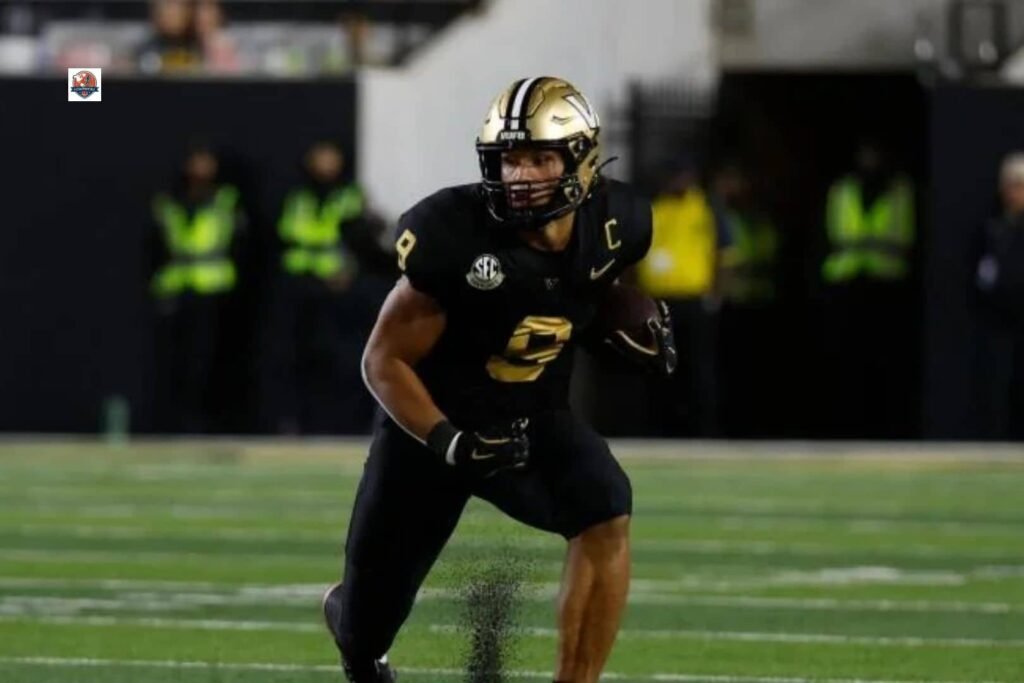
When you watch college football and the NFL draft cycle closely, you start to notice trends before most casual fans do. One of the most compelling themes emerging from the 2026 NFL Draft evaluation period is the idea that certain tight ends — particularly those with truly unique athletic profiles — might actually thrive more as wide receivers at the next level. And leading that conversation this year is Vanderbilt’s Eli Stowers — an explosively athletic, mismatch‑creating weapon who may be better served, both on the field and financially, if he embraces a transition to the wide receiver position.
Why Extremely Athletic Tight Ends Like Eli Stowers Should Welcome
Why Athletic TEs Like Eli Stowers Should Welcome This
Stowers’ journey to NFL prospect status didn’t start with a media spotlight. In fact, his path has been unconventional. A former quarterback recruit at Texas A&M, Stowers eventually found his way to tight end after transferring schools and embracing a completely new role on offense. What he lacked early in his tight end apprenticeship was experience — particularly as a blocker — but what he quickly added was production, athleticism, and a growing sense among scouts that he was something really special.
By the end of his collegiate career at Vanderbilt, he had done more than just catch passes — he led all Football Bowl Subdivision tight ends with 769 receiving yards in his final season and was recognized as the nation’s top tight end with the John Mackey Award.
Yet it wasn’t just his on‑field numbers that caught attention — it was his physical gifts.
An Athletic Profile That Stops You in Your Tracks
At the 2026 NFL Combine, Stowers turned heads the way only truly rare athletes can. He leapt to a 45.5‑inch vertical jump and an 11‑foot‑3 broad jump — both all‑time records for a tight end at the event. Those numbers didn’t just set positional records — they leapt past them in a way that broadcast athletic potential louder than any stat line could.
When NFL Network analyst Daniel Jeremiah referenced Pittsburgh Steelers receiver DK Metcalf in comparison to Stowers, the reaction was immediate — and somewhat surprising. On the surface, the comparison didn’t stick: Metcalf is known for rare NFL‑caliber speed and power, having run a 4.33 in the 40‑yard dash early in his career. Stowers checked in at 4.51 — a great time for a tight end, but more average when compared to a typical NFL receiver’s range.
Nonetheless, the point was this: when you combine that kind of leaping explosiveness with speed that’s rare at his size, you get a player who can create mismatches in the passing game that few traditional tight ends can. And that’s exactly where the idea of a position shift starts to make sense.
Why the Speed Numbers Don’t Tell the Whole Story
A 4.51 40‑yard dash isn’t going to make a receiver’s highlight reel — at least not on its own. But context matters. Not every explosive wideout runs sub‑4.4 — and not all great receivers are vertical track stars. And for Stowers, there’s a compelling proof point in the fact that his speed workout came while still recovering from a hamstring issue that limited his preparation leading up to the Combine. In his own words, he wasn’t even planning to run the 40 until the night before the actual test, because he had only recently regained full health.
Put another way: Stowers’ physical ceiling might actually be higher than the official time indicates. With a clean off‑season of training and preparation, his game‑speed could inch toward what NFL evaluators like to see from perimeter pass catchers.
Does Blocking Still Matter?
This is where the debate gets honest. Stowers’ blocking has been a sticking point in evaluations — and for good reason. Traditional NFL tight ends are expected to hold up in the run game, engage defenders in the trenches, and provide value beyond just catching passes. Stowers’ best film comes when he’s detached from the formation, running routes, creating separation, and leveraging his size and athleticism to win. When he’s asked to anchor as an inline blocker, that’s where the limitations — whether technical or strength‑based — show up.
That’s exactly why some teams aren’t just thinking about him as a tight end anymore — they’re looking at him as a potential wide receiver. NFL Media has reported that multiple teams have evaluated him in that light, recognizing that slot duties and outside roles might better suit his instinctive playmaking skills.
In college, Stowers functioned more like a modern hybrid weapon than a traditional Y tight end. He lined up in the slot frequently and even outside — showing receiving chops from multiple alignments — and he produced from those spots. That kind of flexibility is exactly what offensive coordinators covet in pass catchers.
A Comparision That Makes Sense: Mike Evans Over Metcalf
If we’re going to attach a frame of reference to Stowers’ athletic profile, it might make more sense to think in terms of someone like Mike Evans than Metcalf. Evans, at 6‑4 and over 230 pounds, ran a 4.53 at his Combine — nearly identical to Stowers — and became one of the NFL’s most reliable boundary receivers. He used size, body control, and instincts to beat defenders in the air — not just pure track speed.
If Stowers can cultivate similar skills — release technique, separation timing, route nuance, and defender‑reading ability — he could become a big‑slot or even outside threat with legitimate NFL value.
The Financial Argument: Why Wide Receiver Pays More
Athletic potential and football fit are one thing; actual NFL economic reality is another. Here’s a hard truth: even elite tight ends tend to be paid significantly less than receivers of similar playmaking output. And while there will always be exceptions — George Kittle, Travis Kelce, and a few others — those are outliers rather than the rule.
When you look at recent contracts, the numbers paint a clear picture:
- Tight ends, even highly productive ones, rarely top $20 million per year in average salary.
- Wide receivers, even those drafted in the second round, commonly eclipse that number once they’ve proven themselves in the league.
There are currently more than 20 wide receivers with contracts averaging more than the top‑paid tight end, and the market gap between the two positions has only grown in recent years. This is not just anecdotal — this is numbers‑driven financial reality.
For someone like Stowers, who has the physical skill set to function as a move‑type receiver, accepting a lower draft spot in exchange for positioning himself at a higher‑paying position long‑term might be worth it.Why Extremely Athletic Tight Ends Like Eli Stowers Should Welcome.
Yes, guaranteed money drops significantly between a mid‑second and a late‑third round pick. But the difference in long‑term potential earnings between a steady wide receiver and a tight end — particularly one whose strength is separation and catch ability rather than blocking — is meaningful. If Stowers’ goal is a long career with upside both on the field and on payday, this is an important conversation. Why Extremely Athletic Tight Ends Like Eli Stowers Should Welcome.Why Extremely Athletic Tight Ends Like Eli Stowers Should Welcome
Blueprints Already Exist
NFL history has examples of players transitioning positions and thriving. Some, like the shift of Micah Parsons from off‑ball linebacker to edge rusher, have become defensive evolution case studies. Others have moved from college tight end to NFL receiver — and when the transition works, it pays off Why Extremely Athletic Tight Ends Like Eli Stowers Should Welcome.
Even teams like the Los Angeles Rams inadvertently showed a blueprint for hybrid usage when they lined up tight ends in receiver spots due to injuries at wideout. The result was mismatches that only players with the kind of athletic profile Stowers brings could exploit. The more a coaching staff can put such a player in space — where he’s running routes rather than taking on linemen — the more valuable he becomes Why Extremely Athletic Tight Ends Like Eli Stowers Should Welcome. Why Extremely Athletic Tight Ends Like Eli Stowers Should Welcome
Maximizing Mismatch Creation in an Evolving NFL
The NFL is a league that rewards mismatch creators — players defenses struggle to cover because they don’t fit neatly into a traditional position box. That’s exactly the kind of profile Stowers brings:
- A big catch radius
- Explosive leaping ability
- Strong hands and yards‑after‑catch instincts
- Route versatility from multiple alignments
These traits don’t just fit a modern tight end role — they fit a modern receiver role.
And while he may not have blazing 4.30‑type speed, wide receivers don’t necessarily need track‑star speed to be successful in today’s pass‑first league. What matters more is the ability to find soft spots in coverage, use size to win contested throws, and turn small gains into larger ones after first contact. Those are exactly the areas where Stowers has shown promise on tape Why Extremely Athletic Tight Ends Like Eli Stowers Should Welcome.
Final Thoughts: Smart Players Adapt
Why Extremely Athletic Tight Ends Like Eli Stowers Should Welcome NFL careers are short, and the margin between role player and star is thin. For athletes like Stowers, who possess skills that don’t fit the conventional tight end mold but might flourish as a receiver, embracing a new identity at the next level isn’t about abandoning who you are — it’s about maximizing your strengths.
The choice isn’t easy. Draft position matters. Rare athleticism is valuable. But the league is evolving. Schemes are innovating. And the definition of wide receiver has expanded to include bigger, more versatile athletes who can do more than traditional receivers did a decade ago Why Extremely Athletic Tight Ends Like Eli Stowers Should Welcome.
If Stowers wants to build not just an NFL career, but a great one — on the field and in contract negotiations — then being open to a transition isn’t just smart… it might be the best decision he ever makes.
Why Extremely Athletic Tight Ends Like Eli Stowers Should Welcome. Why Extremely Athletic Tight Ends Like Eli Stowers Should Welcome
