

Nobody handed the San Antonio Spurs anything.
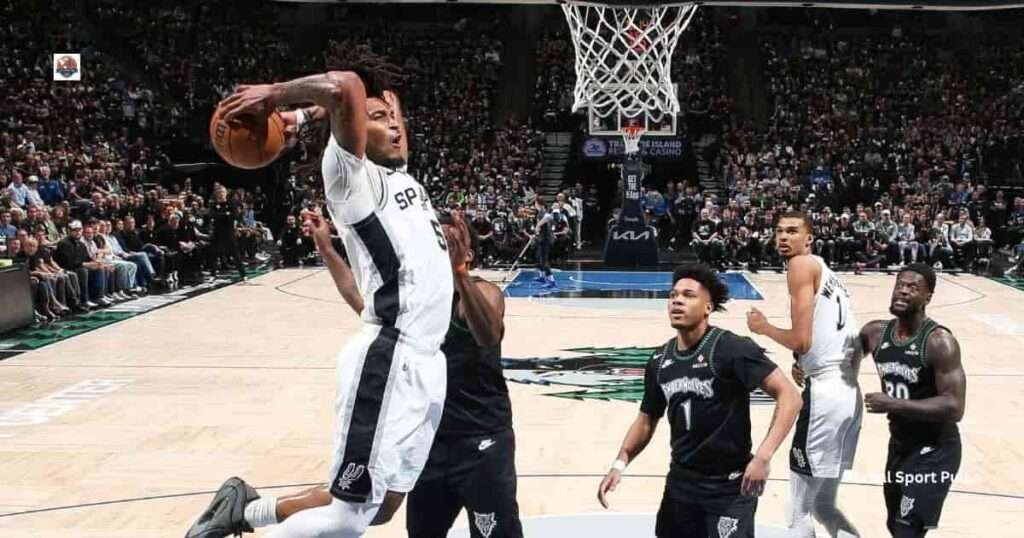
While the Oklahoma City Thunder steamrolled their way through the first two rounds with the quiet efficiency of a machine that refuses to break down, the Spurs carved a more complicated, more telling path. They beat Portland in five. They dismantled Minnesota in six. And through it all, they absorbed punches, adjusted, and kept coming — because that, more than any advanced metric, is what defines this version of San Antonio.
Eight wins. Three losses. A point differential of +15.2 per 100 possessions. The numbers are staggering, and yet somehow, they don’t fully capture the texture of what this Spurs team has become.
A Defense That Suffocates
Let’s start where everything begins for San Antonio: defense.
The Spurs own the best defensive rating in this year’s playoffs — 102.2 points allowed per 100 possessions. That isn’t a coincidence, and it isn’t a fluke. It is the direct byproduct of a defensive system that operates with ruthless precision. In the first round, they held the Portland Trail Blazers to 10.9 fewer points per 100 possessions than Portland had scored during the regular season. Then, against a Minnesota Timberwolves offense that had been rolling in the first round, San Antonio tightened the vice further — holding them to 10.6 fewer per 100 than they had been averaging.
Think about that. Two consecutive rounds. Two consecutive, significant drops in opponent offensive efficiency. That’s not scheme alone. That’s execution at the highest level, sustained over weeks.
The Spurs lead the playoffs in opponent field goal percentage inside the paint, holding teams to just 47.1% in the restricted area — a figure that speaks directly to the presence of one man. They rank third in opponent free throw rate. Fourth in defensive rebounding percentage. The structure is sound from every angle. And at the center of it all, literally and figuratively, stands Victor Wembanyama.
Wembanyama: Imperfect, Unstoppable
Here is the fascinating contradiction at the heart of San Antonio’s playoff run: Victor Wembanyama has not been at his statistical peak, and the Spurs have still been dominant.
A tough setback in Game 2 of the opening round.
A tough setback in Game 2 of the opening round. An ejection in Game 4 against Minnesota. Blowout garbage time eating into his minutes. The result? He’s averaging just 28.8 minutes per game through the first two rounds — well below what anyone anticipated heading into the postseason. His shooting from outside the paint has been poor by his standards, connecting on just 30% of those attempts. His scoring average of 25.4 points per 36 minutes is down noticeably from the 30.9 he posted during the regular season.
And yet.
His true shooting percentage sits at 65.3%, second-best among all players averaging at least 20 points per game in these playoffs. Why? Because Wembanyama has made a critical adjustment — he’s attacking the paint with unprecedented ferocity. A remarkable 56% of his total shot attempts have come inside the paint this postseason, up from 50% in the regular season, and he’s converting those at a staggering 73% clip. Seventy-three percent. That is not a number that belongs in an era of perimeter-obsessed basketball. It is a number that belongs to a player who is finding new ways to dominate even when one part of his game isn’t clicking.
His defensive footprint, meanwhile, remains transformative. The Spurs have held opponents to 9.8 fewer points in the paint per 100 possessions during his 126 minutes on the floor. That single statistic, perhaps more than any other, explains why San Antonio’s defense is the best remaining in these playoffs.
The Young Core That’s Growing Up Fast
Wembanyama is the centerpiece, but he is not the only story.
Stephon Castle has emerged as a genuine offensive weapon at the worst possible time for opposing defenses — the playoffs. Over his last 26 games, Castle has shot 44.6% from three-point range, a figure that transforms him from a potential liability into a genuine floor spacer. Teams can no longer sag off him. They can no longer send a second body toward Wembanyama on the weak side and assume Castle won’t punish them for it.
Then there’s Dylan Harper. Quiet. Efficient. Devastating. Harper’s effective field goal percentage in the playoffs is 61.1%, ninth-best among all players with at least 75 field goal attempts. For a rookie navigating the speed and physicality of playoff basketball, that kind of efficiency is extraordinary. He isn’t just surviving this stage — he’s thriving in it.
The Spurs have been their absolute best — a plus-19.3 per 100 possessions — when Castle and Harper share the floor together. That pairing has become San Antonio’s most reliable offensive combination, even as veteran De’Aaron Fox (who broke out of a brief slump with a strong Game 6 in Minnesota) continues to anchor the rotation with experience and poise.
This isn’t a one-man team anymore. It never really was.
The Challenge Ahead: Oklahoma City
The Western Conference Finals presents the Spurs with their most complex puzzle yet.
Oklahoma City swept both the Phoenix Suns and the Los Angeles Lakers without a single loss, posting an offensive rating of 126.3 points per 100 possessions — the best eight-game offensive stretch the Thunder have put together all season. They protect the ball, they crash the offensive glass at a rate that jumps dramatically from their regular-season numbers, and they have Shai Gilgeous-Alexander returning from injury just in time for the series to begin.
The possession battle will be critical. The Spurs have averaged 4.3 fewer shot opportunities per game than their opponents through two rounds — the third-worst differential in the playoffs. Oklahoma City, by contrast, has generated 4.6 more than their opponents — the second-best. If San Antonio bleeds live-ball turnovers and allows OKC’s transition offense to ignite before Wembanyama can retreat and anchor the defense, the Thunder’s offensive machine will be very difficult to stop.
Paint points will define this series. Both defenses are elite at protecting the basket. The regular season was a split affair, with the advantage in the paint shifting depending on the game — and on whether Wembanyama was on the floor. In his 126 minutes against OKC this season, the Spurs outscored the Thunder in the paint in some contests and absorbed a 9.8-point-per-100 deficit in others. There’s no comfortable answer here. Only competition.
Why This Series Feels Different
History warns us not to trust dominant teams from the first two rounds. The 2019 Milwaukee Bucks were 10-1, outscoring opponents by 15.3 points per game — and then lost four straight to Toronto. Dominance, it turns out, doesn’t guarantee anything once the opponent gets a full week to prepare and the sample size shrinks to a best-of-seven.
But the Spurs aren’t just a team riding momentum. They are a team with a genuine defensive identity, a superstar who is still discovering new dimensions of his game, and a young core that appears to grow more dangerous with every passing round. They have been here before — or at least, their franchise has. Nine years removed from their last conference finals appearance, San Antonio returns not as a nostalgic footnote, but as a legitimate contender.
The Thunder are the favorite. Their depth, their offensive firepower, and their perfect playoff record demand that respect. But the Spurs? The Spurs are built to make favorites uncomfortable.
And that’s precisely what makes this series worth watching.
Click here: Spurs vs Thunder: Western Conference Finals Preview – Fox Ankle Injury Looms Over San Antonio
